Undergraduate Research in the Age of AI Presented at ASEE Mid-Atlantic 2026
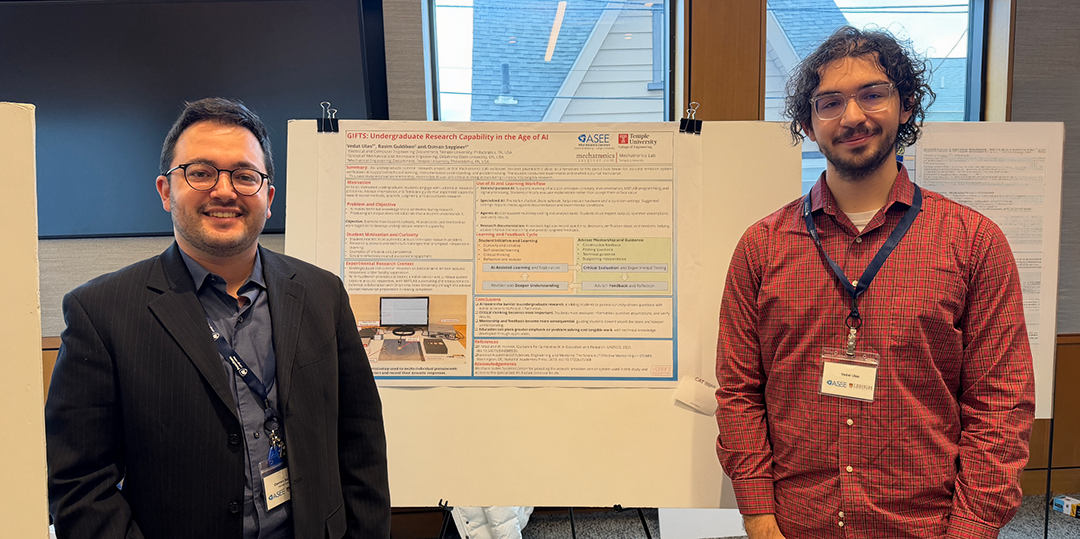
Dr. Osman Sayginer (left) and undergraduate researcher Vedat Ulas (right) at the ASEE Mid-Atlantic Section 2026 Fall Conference.
Undergraduate researcher Vedat Ulas and Dr. Osman Sayginer presented their work, “Undergraduate Research Capability in the Age of AI,” at the ASEE Mid-Atlantic Section 2026 Fall Conference, held November 13–14, 2026, at Lehigh University in Bethlehem, Pennsylvania.
The presentation shared their research journey during Vedat’s summer undergraduate research project in acoustic emission (AE), highlighting how artificial intelligence (AI) tools can lower the technical barriers to undergraduate research and enable students to tackle challenging engineering problems earlier in their academic careers.
Throughout the project, Vedat used generative AI tools to independently learn unfamiliar technical concepts, including acoustic emission principles, instrumentation, signal processing, and MATLAB programming. He also utilized Vallen Brain, a specialized AI assistant developed by Vallen Systeme GmbH for acoustic emission systems, sensors, and instrumentation, to better understand the hardware, measurement settings, and system configuration.
We sincerely thank Vallen Systeme GmbH for providing the acoustic emission sensor system and access to Vallen Brain. Their support contributed to both the experimental research and the exploration of AI-assisted undergraduate learning.
Rather than relying on extensive prerequisite coursework, Vedat acquired much of the necessary knowledge as research challenges emerged. Dr. Sayginer provided mentorship, technical guidance, and continuous feedback, helping Vedat critically evaluate AI-generated information, validate experimental results, and develop sound research practices.
The research investigated low-cost piezoelectric disks for acoustic emission system verification, with the goal of developing the experimental findings into a scientific manuscript.
Through this presentation, Vedat and Dr. Sayginer shared both the opportunities and challenges of AI-assisted undergraduate research. Their experience demonstrates how AI can lower the threshold for entering research while enabling meaningful scientific outcomes, provided that student curiosity, critical thinking, hands-on experimentation, and faculty mentorship remain central to the process.
The work highlights the potential of AI to make undergraduate research more accessible, allowing motivated students to pursue authentic engineering problems and develop research capabilities through direct experience.
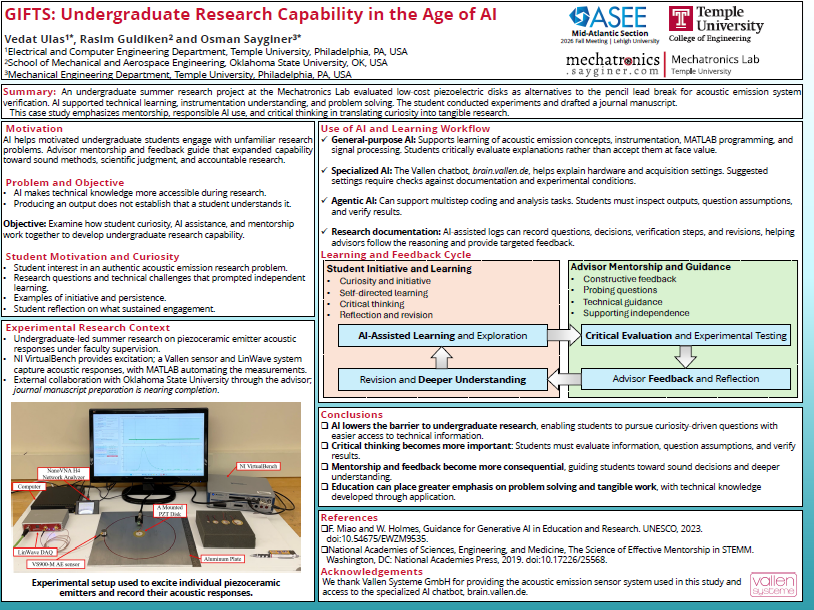
Research poster titled “Undergraduate Research Capability in the Age of AI,” presenting the AI-assisted undergraduate research experience and its implications for engineering education.