2026 Summer Research at Mechatronics Lab
This summer, five undergraduate researchers have been actively working on a diverse range of projects at the Mechatronics Lab. From developing new systems and building prototypes to troubleshooting, experimenting, attending conferences, teaching, and hosting K-12 students to help address community challenges, our students have engaged in research, education, and outreach. Some have even taken the exciting step of drafting their first research papers. Through these experiences, each student has brought a unique perspective to their research journey.
Here, you will find their summer research experiences, told from their own perspectives. Through their stories, they will share what they worked on, what they learned, the challenges they encountered, and how this experience will shape the next steps in their research and engineering journeys.
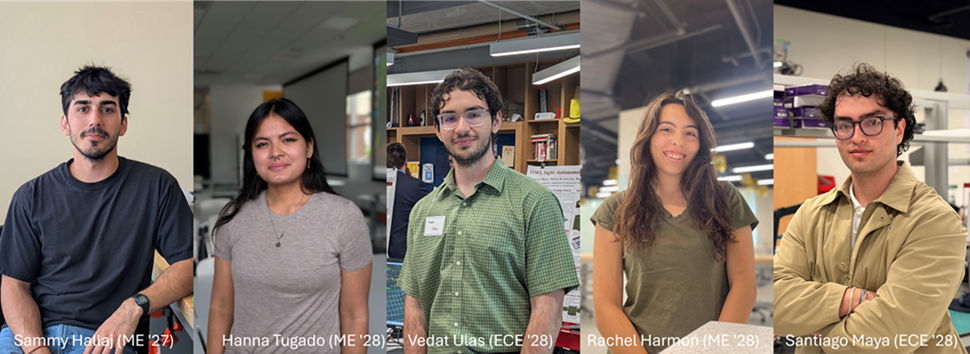
Meet our 2026 Summer Undergraduate Researchers:
Sammy Hallaj (ME ’27)
“I learned to take a dynamic approach to engineering, focusing on optimizing the entire system rather than just individual parts.”
Over the past summer, I worked on two ongoing mechatronics research projects utilizing Acoustic Emission (AE). The first focuses on evaluating bearing life by using AE to detect microfractures before total mechanical failure. For this, I integrated a new Vallen AE system and designed highly stable sensor mounts equipped with thermocouples to monitor temperature differentials during experimental runs. The second project involved building an AE imaging system from scratch, this time using a Mistras AE system. This required me to design a custom precision gantry system under strict constraints to accurately maneuver a transducer and emitter in the water while maintaining spatial coordinates. This involved rail systems, stepper motors, grbl code, and a control system in line with Arduino Uno R3.
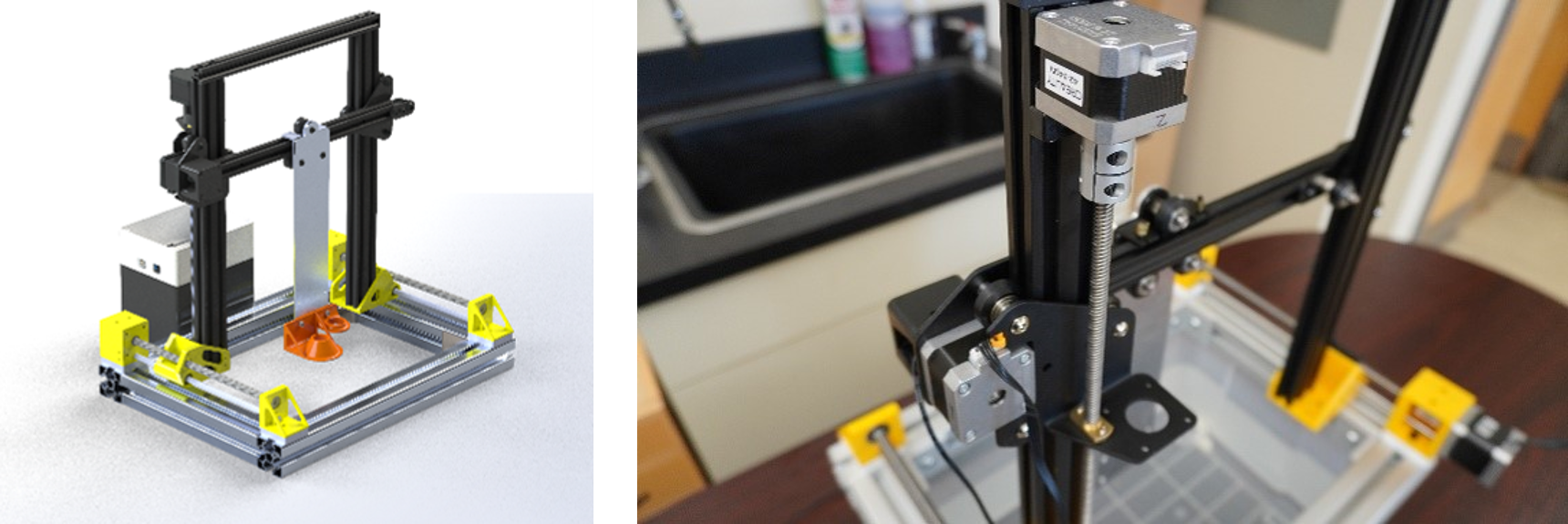
SolidWorks model of the acoustic emission imaging gantry showing the full X, Y, and Z-axis motion (Left); completed acoustic emission imaging gantry showing the Y- and Z-axis movement using belts and lead screws (Right).
Throughout both projects, I learned to take a dynamic approach to engineering, focusing on optimizing the entire system rather than just individual parts. Building these setups gave me valuable, hands-on experience with G-code, machine calibration, and running stress simulations on 3D-printed parts of varying densities. Navigating hurdles like budget limitations and working around constrained components has been a great learning experience. Both experiments are still active, and they will require continuous iteration and advancements as new evaluations arise
Hanna Tugado (ME ’28)
“Teaching engineering design helped refine my own design and leadership skills, and solidified my belief that collaboration is what makes better engineers.”
This summer I mainly focused on mentoring high school students for Temple + Heights STEM Lab through engineering design. Students delved into local community needs, deciding to focus on engineering solutions for the high rates of car theft in South and Southwest Philadelphia. While students lead the focus of the project and proposed their own solutions, I guided them through making their ideas into reality.
Throughout the program, I taught them SolidWorks and the skills needed for engineering design. They also reached out to local community members, including mechanics and car theft victims. By the end of the six-week program, they had developed a 3D-printed anti-car-theft prototype, which they presented at the final showcase.
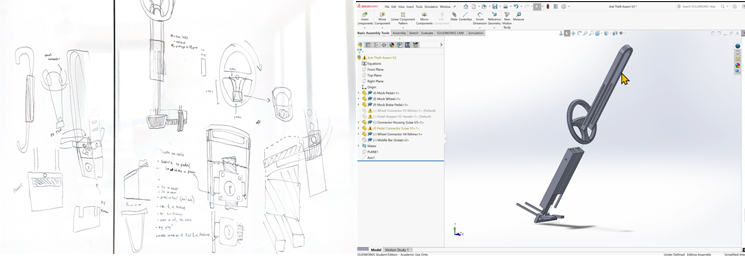
First week vs final week comparison: from initial sketches to final assembly of Anti Car Theft prototype.
Giving them creative control while having to build their engineering skills from ground up was the biggest challenge, but seeing the students progress from not knowing how to make a sketch in SolidWorks to fluently making edits on their model in an assembly made it worth it. It was really rewarding seeing them engaged and invested in their project. In the end they seemed really proud of their work, and said themselves that the progress and final results they had achieved felt surreal.
And while this program focused on mentoring students, in the end I also learned a lot from them. Teaching engineering design helped refine my own design and leadership skills, and solidified my belief that collaboration is what makes better engineers.
Vedat Ulas (ECE ’28)
“This experience taught me to look beyond simply following established procedures and instead think about how engineering methods themselves can be improved.”
This summer, my research in the Mechanical Engineering Department at Temple University focused on improving how engineers test and monitor the health of structures. I worked on finding a more reliable alternative to the traditional “pencil lead break” test used in Acoustic Emission (AE) testing, which helps engineers detect small changes in structures such as bridges and aerospace components.
Through extensive testing, I explored the use of low-cost piezoelectric disks as a more consistent and repeatable way to verify AE systems. My work showed that these small, inexpensive components can provide a more reliable signal than the traditional method while also helping us better understand the reasons behind inconsistencies in the standard testing process. This experience taught me to look beyond simply following established procedures and instead think about how engineering methods themselves can be improved.
I am currently working on a draft of a research paper based on this work, with the goal of pursuing potential publication.
Separate from my AE research, another highlight of the summer was presenting our work on improving the electronics of the OWL-Sight system at the 2026 NDIA DVC Aerospace Conference. The opportunity to engage with industry leaders and academic peers helped me become more confident in communicating technical ideas and showed me that there are often multiple ways to approach an engineering challenge.
I was also incredibly honored that our work received the Best Undergraduate Research Award at the event.
Overall, this summer has given me the opportunity to grow not only as an engineer and researcher, but also as a communicator and problem-solver. I’m excited to continue building on these experiences and see where these projects take me next.
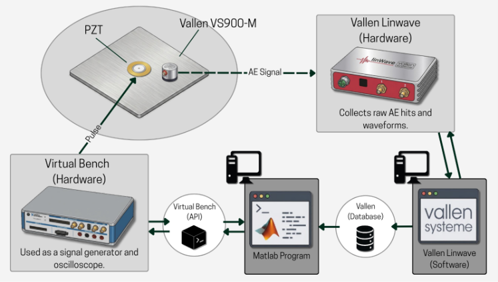
Experimental setup and data loop diagram illustrating the integration between the signal excitation and acoustic acquisition systems. A VirtualBench hardware unit drives the surface-coupled PZT disk on the test plate, while the generated acoustic wave is detected by a Vallen VS900-M sensor, recorded via Linwave hardware, and processed automatically through custom MATLAB scripts.
Rachel Harmon (ME ’28)
“Because the project is self-directed, I have learned how to teach myself what I need to know, manage my time, and ask for help when needed.”
I am completing my research as a part of the Diamond Research Sholars program, a small multidisciplinary cohort of undergraduate students who run their own research projects over the summer and fall semester. My project, titled “Development of a Thermal Stimulation Device for Assessing Vascular Reactivity in Functional Microvascular Diagnostics”, seeks to expand upon current imaging techniques for cardiovascular disease diagnosis and monitoring. Essentially, my project involves creating a device which can apply a highly controllable stimulus to the skin in order to monitor the responsiveness of the smallest vessels in that tissue. This can not only be used in further studies of microvasculature but can also be used clinically in the diagnosis and monitoring of cardiovascular diseases.
Because changes in microvascular function can be associated with cardiovascular health, developing noninvasive ways to assess these responses is an exciting area of research. I have learned so much about electronics, coding in Python and C++, material selection, and design work. This has been challenging, given that my knowledge of electronics and coding was very minimal at the start of this project. Because the project is self-directed, I have learned how to teach myself what I need to know, manage my time and set my own deadlines, and ask for help when needed. I have become a much more well-rounded engineer because of it.
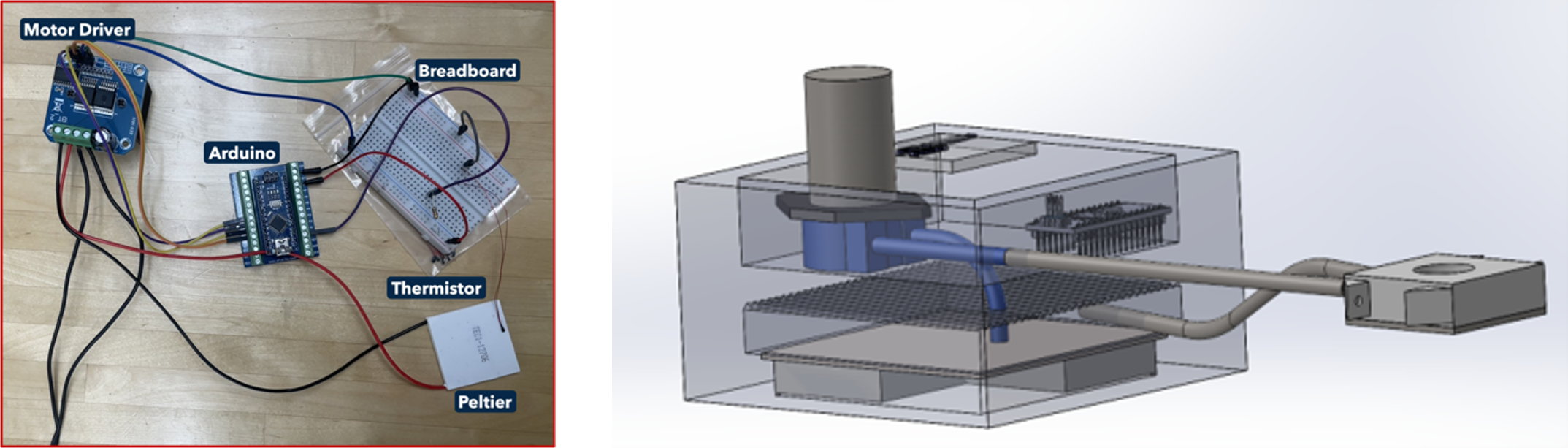
Left: Early prototype of the device using a Peltier element to directly heat and cool the tissue; Right: SolidWorks design of the second prototype, which uses a water pump system to separate the skin from the heating and cooling elements.
Santiago Troya Maya (ECE ’28)
“This hands-on integration of embedded systems and control theory fundamentally shifted my perspective on engineering, demonstrating exactly how classroom concepts translate into real-world technologies.”
This summer, I worked as a researcher, working on the project OWL-Strike, an autonomous FPV Drone Engagement and Neutralization System. Designed to address the escalating security threats of unauthorized drones without relying on explosives or indiscriminate jamming, my research focused on engineering a safe, precision-based interception method. To achieve this, I developed a closed-loop autonomous navigation system using Qualisys motion-capture for real-time spatial tracking. By reverse-engineering a stock drone flight controller, I replaced its physical components with digital potentiometers, allowing an Arduino to emulate RC stick inputs driven by MATLAB-computed PID control outputs. This hands-on integration of embedded systems and control theory fundamentally shifted my perspective on engineering, demonstrating exactly how classroom concepts translate into high-impact, real-world technologies.
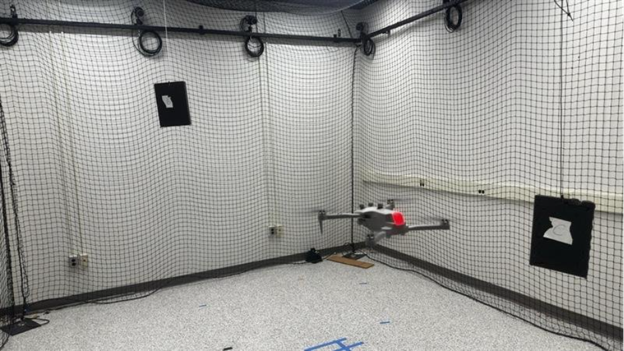
Testing the drone autonomous control during an experimental run. This setup was used to measure the precision of the system and for determining the position using the Motion Capture Unit at the IDEAS Hub.
The most rewarding culmination of this research was presenting our findings at the 2026 NDIA DVC Aerospace Conference. Engaging with industry leaders and academic peers refined my ability to communicate technical concepts and reinforced that there are multiple ways to approach a single engineering challenge. In addition to this, I am incredibly honored that our work was recognized with the Best Undergraduate Research Award at the event. Building on this momentum, the current focus is on designing and manufacturing our own custom drone. This next phase will accelerate our iterative testing process and expand the operational capabilities of OWL-Strike.