From the Mechatronics Lab to Northrop Grumman
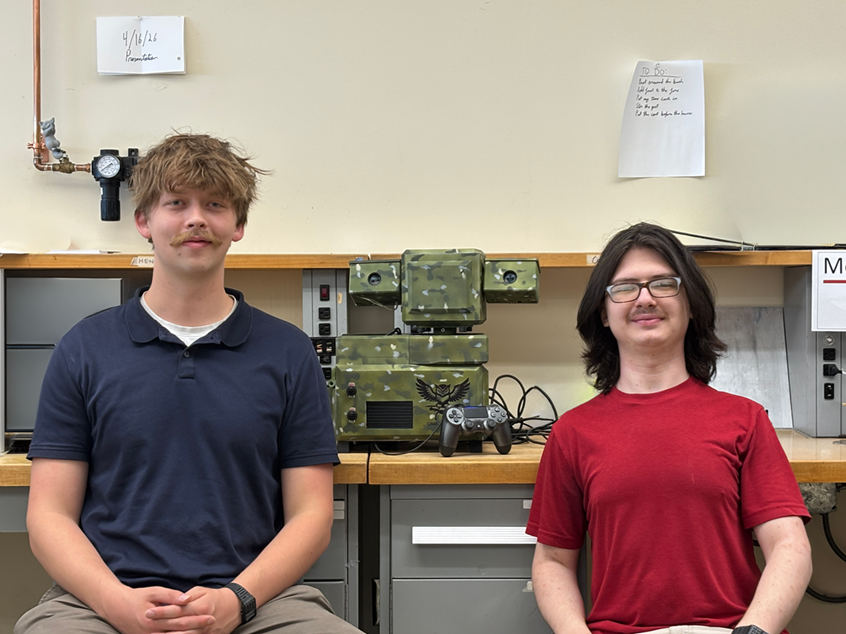
Henry Krumrine and Connor (L–R), developers of OWL-Sight, back in the Mechatronics Lab after completing their summer internships at Northrop Grumman.
Two standout members of the Temple Mechatronics Lab—the lead engineers behind the OWL-Sight detection system—spent this past summer as engineering interns at Northrop Grumman Mission Systems. Now back on campus as graduate students in Temple’s 4+1 Master’s program, both have secured full-time post-graduation job offers with the company in Baltimore.
OWL-Sight, an acoustic-optical counter-UAV detection system developed as their senior design project under the direction of Dr. Osman Sayginer, fuses a custom four-microphone acoustic array with stereo computer vision to autonomously detect, track, and cue countermeasures against low-altitude unmanned aircraft. The system earned top honors with the Best Undergraduate Research Award at the 2026 NDIA Delaware Valley Chapter Aerospace Conference—delivering acoustic bearing estimation, visual tracking, real-time classification, and motorized pan-tilt tracking in an accessible platform built for under $2,000.
We sat down with Henry and Connor to discuss their transition from undergraduate senior design to defense aerospace, how hands-on lab prototyping prepared them for industry, and what’s next for OWL-Sight.
1. Can you briefly describe OWL-Sight for those unfamiliar with it?
-
Henry: OWL-Sight is a semi-autonomous acousto-optic sensing system developed for counter-UAV integration against low-altitude FPV drones. A turret-mounted camera system employs computer vision and stereo vision techniques to acquire, track, and estimate the 3D position of airborne targets. When optical line-of-sight is degraded or unavailable, an acoustic localization subsystem provides complementary cueing and bearing information to reacquire the target. The multi-modal fusion enables robust situational awareness across challenging visibility conditions.
-
Connor: The system tracks low-altitude UAVs for cueing existing or experimental countermeasures. By combining computer vision object recognition with acoustic triangulation, OWL-Sight operates completely passively—unlike traditional radar systems that emit detectable RF signatures.
2. What were your primary technical roles in building the system?
-
Henry: I designed and implemented the acoustic localization subsystem and led the mechanical design and CAD modeling of the physical chassis and turret.
-
Connor: I led the computer vision pipeline, motorized target tracking programming, machine theory calculations, and overall system integration.
3. How did working in the Mechatronics Lab shape the project?
-
Henry: The Mechatronics Lab gave us a dedicated, flexible testbed where we could continuously iterate, test physical hardware, and push beyond standard classroom boundaries. Dr. Sayginer’s mechatronics expertise gave us invaluable technical guidance whenever we encountered roadblocks outside our immediate comfort zone.
-
Connor: Having open lab access enabled rapid experimentation with novel tracking algorithms, control schemes, and sensor configurations. The lab fosters an environment where students and faculty seamlessly combine hands-on experimentation with analytical theory.
4. What was the toughest technical obstacle you had to overcome?
-
Henry: Achieving precise, repeatable acoustic triangulation was definitely our hardest challenge. Dealing with asynchronous sensor sampling, real-time signal phase matching, and sporadic electrical noise/voltage spikes required extensive filtering and debugging.
-
Connor: Bridging the gap across mechanical, electrical, and computational domains was an intense learning curve—especially making sure our motor control loops responded fast enough to real-time vision inputs without introducing tracking oscillation.
5. What did your work look like at Northrop Grumman Mission Systems this summer?
-
Connor & Henry: Northrop Grumman Mission Systems focuses on developing advanced electronics, software architectures, and specialized multi-spectral sensor payloads. Working in that environment gave us firsthand exposure to how defense-scale systems are architected and rigorously tested.
6. Which skills from your senior design project transferred most directly?
-
Henry: Mechanical CAD modeling and design for manufacturing were directly applicable from day one. Navigating complex assemblies during our senior design prepared me well for industry toolsets.
-
Connor: High proficiency in CAD packages like SolidWorks and Siemens NX, alongside practical knowledge of sensors, actuators, and signal interfaces, directly aligned with the projects underway at Mission Systems.
7. What was the most noticeable difference between lab design and industry engineering?
-
Henry: Scope and specialization. On a senior design team, you wear every hat—you are the architect, machinist, programmer, and test technician. In industry, projects are vastly larger and more structured; engineers typically tackle deep, focused components within a much larger multidisciplinary workflow. Both models are uniquely rewarding.
-
Connor: A student project feels like being the master architect—you make high-level decisions that define the entire system. In industry, the focus shifts to hyper-specific tasks across multiple interconnected programs, demanding deep rigor and compliance with established engineering standards.
8. What are your immediate plans following completion of the 4+1 Master’s program?
-
Henry: I’ll be joining Northrop Grumman full-time at their Baltimore facility.
-
Connor: I will also be launching my full-time engineering career with Northrop Grumman in Baltimore.
9. What’s next for OWL-Sight during your graduate studies?
-
Henry: We are working on fully characterizing the acoustic-optical tracking performance, refining system calibration, and executing hardware revisions to maximize detection consistency and operational range.
10. Looking back, what milestone from the project are you proudest of?
-
Connor: Looking at the finished, functioning motorized turret tracking live targets, I was proudest of the fact that we engineered, wired, and integrated the entire multi-sensor embedded system successfully as a mechanical engineering team without dedicated electrical engineering support.
11. What advice do you have for undergraduate students targeting defense or aerospace internships?
-
Connor: Understand the operational landscape. If your project addresses an active, real-world challenge—such as low-cost asymmetric drone threats—it immediately stands out to technical recruiters. High-tech industries value engineers who can balance practical constraints with innovative problem-solving.
12. Where do you see counter-UAS technology heading over the next few years?
-
Connor: We are observing an asymmetric cost race. Modern low-cost loitering munitions and FPV drones are effective precisely because traditional countermeasures cost orders of magnitude more to deploy. Moving forward, scalable defenses will prioritize passive multi-sensor detection, low-cost interceptors, and robust physical/electronic countermeasures.
We are proud of Henry and Connor for carrying the curiosity and engineering rigor cultivated in the Temple Mechatronics Lab into industry, and we are excited to see them continue advancing counter-UAS research as graduate students.